
Blog
How long does aligner treatment take?
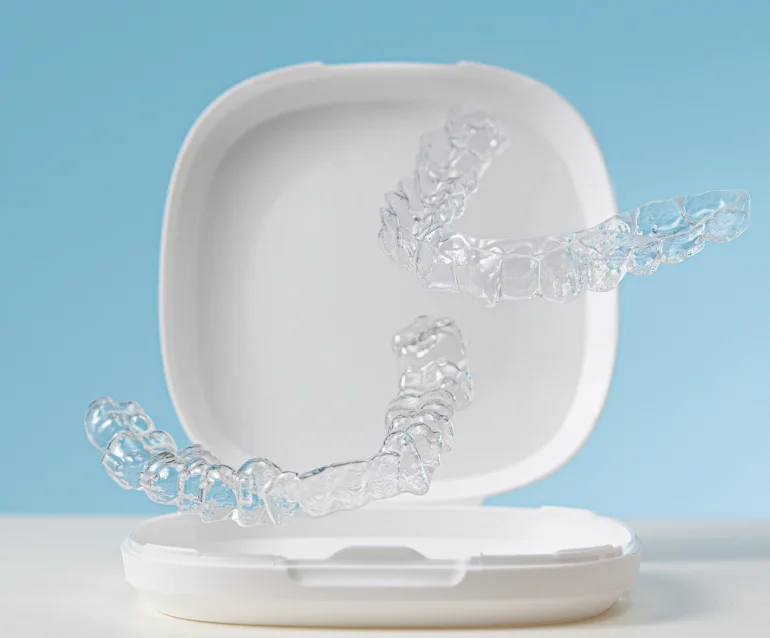
When it comes to straightening teeth with aligners, one question comes up more often than any other at the orthodontist’s: “How long will the treatment actually take?” Straightening teeth is a journey that requires time, commitment and patience from the patient. Let’s look at the process and the factors that affect its length.
The length of aligner treatment depends on individual factors. On average, it takes about one to two years. In some cases teeth can be straightened faster, for example in 8 months, but this depends on the specific bite problem and on how consistently the patient wears the aligners. When the treatment plan is drawn up and at check-ups, the orthodontist can give a more precise estimate.
To predict how long treatment will take, we first collect information: scans, photos, a panoramic X-ray and a lateral X-ray. Based on this, a detailed treatment plan is drawn up that describes the treatment step by step in text and images. So before treatment starts and the aligners are ordered, you can already see the expected final result.
A scan of the teeth is needed for the treatment plan
Once the teeth have been scanned, digital treatment planning can begin, including the initial number of aligners. The number of aligners directly affects the length of treatment.
In more complex cases, the plan may need adjusting, as the actual movement of the teeth can differ from what was expected. In simpler cases, the whole set of aligners is made at once and the patient receives all of them – usually fewer than 20. Each aligner is worn for two weeks and can be taken out briefly for eating and brushing. The minimum wearing time is 22 hours a day. Specific instructions are always given by your orthodontist, who monitors the whole process.
For more complex bite problems, the teeth are scanned again mid-treatment to assess their movement more accurately. Sometimes the plan has to be reassessed and even the direction of tooth movement changed. Moving teeth with aligners requires professional planning and special training.
In some cases, elastics are needed in addition to the aligners. These small rubber bands attach to the aligners, add extra force and speed up treatment. They must be changed every day, sometimes several times a day. If the elastics are not worn and changed, the desired result will not be achieved and treatment will drag on. Sometimes it may seem that the teeth are moving, but in reality they are falling behind and quite a few extra aligners have to be ordered.
Wearing the aligners properly is the key to success
If the aligners are left out for several hours or even days, the teeth start moving back towards their original position. At first the aligner may still fit, but the lag only shows after a few weeks: the aligner no longer sits properly, and this does not improve even after wearing it for a few days.
When you start a new aligner, it is normal that it does not seat immediately. Chewing on a soft “chewie” helps the aligner sit better and the teeth move into place. Clenching your teeth together on the aligners, on the other hand, damages them and causes cracks.
Cracks can also appear from grinding the teeth at night. Many people clench their teeth during the day when stressed, and at night, when relaxed, they start grinding. The teeth should only touch when eating – at other times there should be a gap of about 3 mm. If you watch yourself and avoid clenching, treatment also progresses faster: aligners move the teeth best when there is no clenching force and they do not wear out or break.
Teeth grinding (bruxism) and clenching are complex habits that are not easy to get rid of. It often helps to see a myofunctional therapist, have the bite checked and reduce overall stress levels.
In summary, the length of aligner treatment depends on many factors – the severity of the bite problem, the patient’s age, the structure of the jaws, general health and the skill of the doctor – but the most important is the patient’s own role.
The patient’s role matters most
If the patient does not wear the aligners or follow the doctor’s instructions and appointment times, the desired result will not be achieved. But there is no need to worry if the teeth do not seem to improve straight away. Sometimes tooth movement starts at the back, and gaps appear there first. The front teeth straighten only once space has been created by the movement of the back teeth.
Aligner treatment is a longer process that takes time and discipline – changes do not happen overnight. Book a consultation and we will see whether aligner treatment is the right solution for you.
Is aligner treatment right for you?
Book a consultation – the first visit takes 30 minutes and costs €30.